
By Pedro Seidenthal | August 26, 2026
Over the past ten years, many entrepreneurs made the same decision: open one more unit.
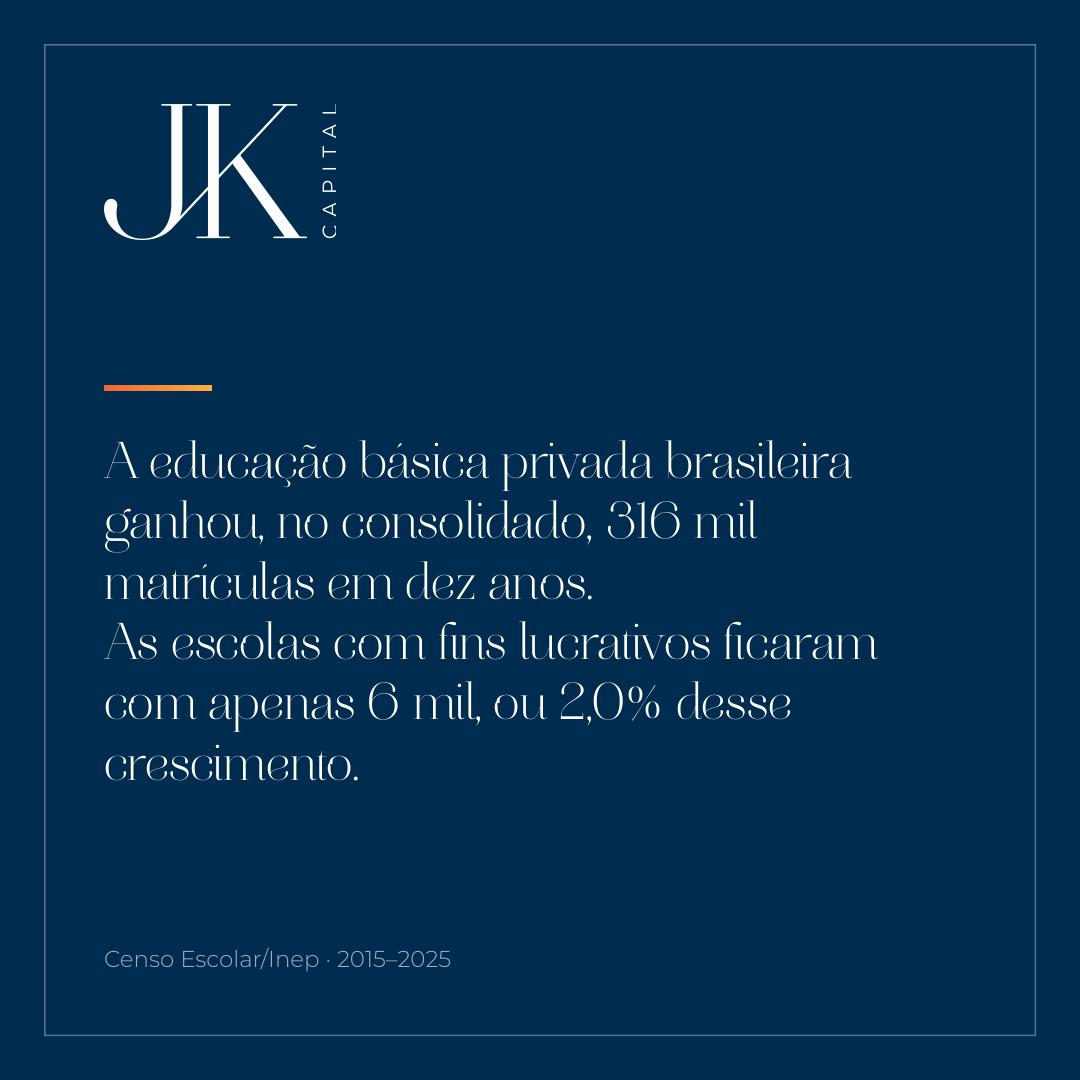
Brazilian private basic education grew by 316,000 enrolments in that period.
That growth, however, did not reach for-profit schools. Three out of every five private-school students study in them, and they captured only 6,000 of the 316,000 new enrolments (2% of the growth). They gained fewer students than cooperatives, which account for less than 1% of the market.
The for-profit segment opened 1,544 new units. The other private categories opened almost the same number, 1,451, and this is where the paths diverge: they filled what they opened and grew 11%, while for-profit schools ended the decade with the same enrolment and saw their average fall from 206 to 194 students per school. A school is a fixed-cost business. Teachers, rent, coordination and administration do not shrink because a class came in three students smaller, and every missing student comes straight out of the margin.
The difference also shows up inside the classroom: across all four teaching stages, classes at for-profit schools have fewer students than at the other categories.
The bill came due in closures. Among small schools operating in 2015, nearly four in ten for-profit ones had ceased operating by 2025. Among small schools in the other categories, just over two in ten.
The losses concentrated at both ends of the cycle: early childhood education, where families choose a school for the first time, and high school, the segment with the highest tuition.
On the other side, a school belonging to a consolidating group has 597 students, three times the category average. And the only group of schools that shrank was the one whose leadership had not been renewed in ten years.
None of this points to a single path. Growing, repositioning, bringing in a partner, acquiring, selling or remaining independent are all legitimate alternatives. What gets shorter over time is the list.
Early planning preserves alternatives.
That is why JK Capital has been advising a growing number of education entrepreneurs on ownership transactions.
The full dataset is in the carousel. School Census/Inep and Receita Federal, 2015 to 2025. Prepared by JK Capital.
K12 Brazil: the growth that never arrived
01 / 11
Slide descriptions
- 01. Cover: private basic education added 316,000 enrolments in ten years; for-profit schools captured 6,000, or 2.0% of that growth.
- 02. Size of each model in 2025: for-profit, 26,500 schools and 5.15 million enrolments (194 students per school); non-profit, 11,463 schools and 2.73 million (238); Sistema S, 870 schools and 315,000 (362); cooperatives, 212 schools and 68,000 (319). Total of 39,045 schools and 8.26 million enrolments.
- 03. Contribution to growth from 2015 to 2025: non-profit, plus 222,000 enrolments (70.2%); Sistema S, plus 81,000 (25.7%); cooperatives, plus 7,000 (2.2%); for-profit, plus 6,000 (2.0%), despite holding 62.3% of private enrolment.
- 04. Enrolments and class size by stage in 2025. In all four stages, for-profit classes are smaller: 10.4 versus 14.2 in early childhood; 15.7 versus 20.0 in lower primary; 21.0 versus 23.0 in upper primary; 25.2 versus 27.0 in high school; 15.4 versus 18.3 overall.
- 05. Change in enrolments by stage between 2015 and 2025. For-profit schools: minus 107,000 in early childhood, plus 35,000 in lower primary, plus 103,000 in upper primary and minus 25,000 in high school. Other private categories grew in all four stages.
- 06. Schools opened and students per school: for-profit schools opened 1,544 units and kept enrolment flat, with the average falling from 206 to 194 students; other private categories opened 1,451 units, grew 11.0% and went from 253 to 248 students per school.
- 07. Schools that ceased operating between 2015 and 2025, by 2015 size: small, 37.8% among for-profit versus 22.9% among the others; medium, 13.9% versus 11.6%; large, 9.3% versus 2.9%.
- 08. Change in enrolment at for-profit schools by age of the youngest shareholder: plus 45.4% up to age 40, plus 22.0% between 41 and 60 and minus 5.8% above 61.
- 09. For-profit schools owned by consolidating groups: 527 units, 597 students per school and enrolment up 21.4%; independent schools: 25,973 units, 186 students per school and enrolment down 1.0%.
- 10. Three national readings: growth was small and did not reach for-profit schools; what separates the models is operations, not the market; scale and leadership renewal go together. Early planning preserves alternatives.
- 11. Notes and sources: private basic education in Brazil, regular schooling, 2015 to 2025, with 39,045 active schools and 8,264,128 enrolments in 2025. Sources: School Census/Inep and Receita Federal; calculated indicators prepared by JK Capital. Not an investment recommendation.
Informational content; it does not constitute an investment recommendation.